


Publishing a product sounds simple until the work around the product starts multiplying.
A source image or product idea becomes a title, description, structured attributes, search metadata, images, mockups, print information, channel listings and publishing tasks. Then the same information has to remain consistent as it moves between systems.
Product content automation is the emerging software category focused on reducing that repetitive work by connecting the creation, enrichment, preparation and publishing of product information.
What counts as product content?
Product content is much broader than a description. It includes the information and media required to explain, discover, evaluate, publish and sometimes produce a product.
- Product names and titles.
- Descriptions and selling copy.
- Specifications and attributes.
- Categories and taxonomy.
- Images and other media.
- SEO titles and meta descriptions.
- Image alt text.
- Materials, dimensions and care information.
- Variants.
- Structured product information.
- Channel-specific listing content.
- Production or fulfilment information where relevant.
The exact fields depend on the product type and destination. A print product requires different information from furniture, software or clothing.
What does product content automation actually automate?
Automation can be introduced at several points in the workflow. It does not have to mean publishing AI-generated content without review.
- Extracting useful information from source product inputs.
- Generating initial descriptions, titles or structured fields.
- Applying business and brand context to generated content.
- Preparing search metadata.
- Checking required product fields before publishing.
- Creating or preparing channel-specific variants.
- Generating supporting product assets or mockups.
- Routing content through review and approval.
- Publishing approved information to connected destinations.
- Synchronising changes when the canonical product record is updated.
Product content automation vs AI product descriptions
AI-generated product descriptions are one capability inside product content automation. They are not the whole category.
A description generator produces text. A product content automation platform can connect the generation step to product data, media, search metadata, review, publishing and downstream destinations.
That distinction is important because the expensive part of product content is often not typing the first draft. It is coordinating everything that happens before and after it.

Product content automation vs product content management
Product content management is the broader operational discipline of creating, structuring, enriching, governing and publishing product information.
Product content automation applies automation to that workflow.
- Product content management defines the information, structure, ownership and workflow.
- Product content automation reduces the manual work involved in creating, transforming, checking and moving that information.
The two concepts therefore support rather than replace one another.
Product content automation vs PIM
A Product Information Management system, or PIM, is commonly used as a central source of structured product information, especially where many suppliers, markets, languages or channels are involved.
A product content automation platform may overlap with some PIM capabilities or integrate with a PIM. The important distinction is that automation is primarily about the work being performed on and around the product information, while a PIM is primarily concerned with managing authoritative product data.
Not every small ecommerce business needs an enterprise PIM. Many businesses manage their core catalog inside commerce platforms and introduce additional content automation as the amount of repetitive work grows.
Product content automation vs PXM
Product Experience Management, or PXM, generally focuses on the quality and consistency of the product experience delivered to customers across channels.
Product content automation can contribute to PXM by producing and maintaining the content required for those experiences, but the concepts are not identical.
What is product content syndication?


Product content syndication is the process of distributing product information from a controlled source into multiple downstream destinations.
The same canonical product may need different field structures, character limits, media requirements or attributes for a storefront, marketplace, fulfilment provider or advertising feed.
Automation becomes particularly useful here because the objective is not simply to copy the same description everywhere. It is to preserve the underlying product truth while adapting information to the requirements of each destination.

Why a connected product record matters
A common cause of content inconsistency is treating every channel output as an independent document.
When product content begins from one connected record, the business can maintain a clearer relationship between the source product and its downstream outputs.
- A title change can be traced back to the same product.
- Search metadata remains associated with the correct item.
- Channel-specific variations do not become entirely disconnected copies.
- Review status can travel with the product workflow.
- Assets, product information and publishing activity remain related.
Where AI fits into product content automation
AI is useful when it works from reliable product and business context rather than receiving an isolated image and being asked to invent everything around it.
For example, useful generation can take into account the actual product, the brand voice, an existing collection, known specifications, the target destination and previously approved product information.
That is another example of the wider MadLabz principle: intelligent products become more useful when they understand the business context around the task.
Human review still matters
Automating content creation does not remove the need for factual accuracy, brand judgement or product-specific expertise.
- AI should not invent product specifications.
- Material and compatibility claims need reliable source information.
- Generated imagery should not misrepresent the actual product.
- Regulated or safety-sensitive claims require appropriate review.
- Channel publishing should respect the business's approval rules.
- The source product record should remain identifiable after transformation.
The strongest automation workflows reduce repetitive work while preserving a clear path for review where judgement is needed.
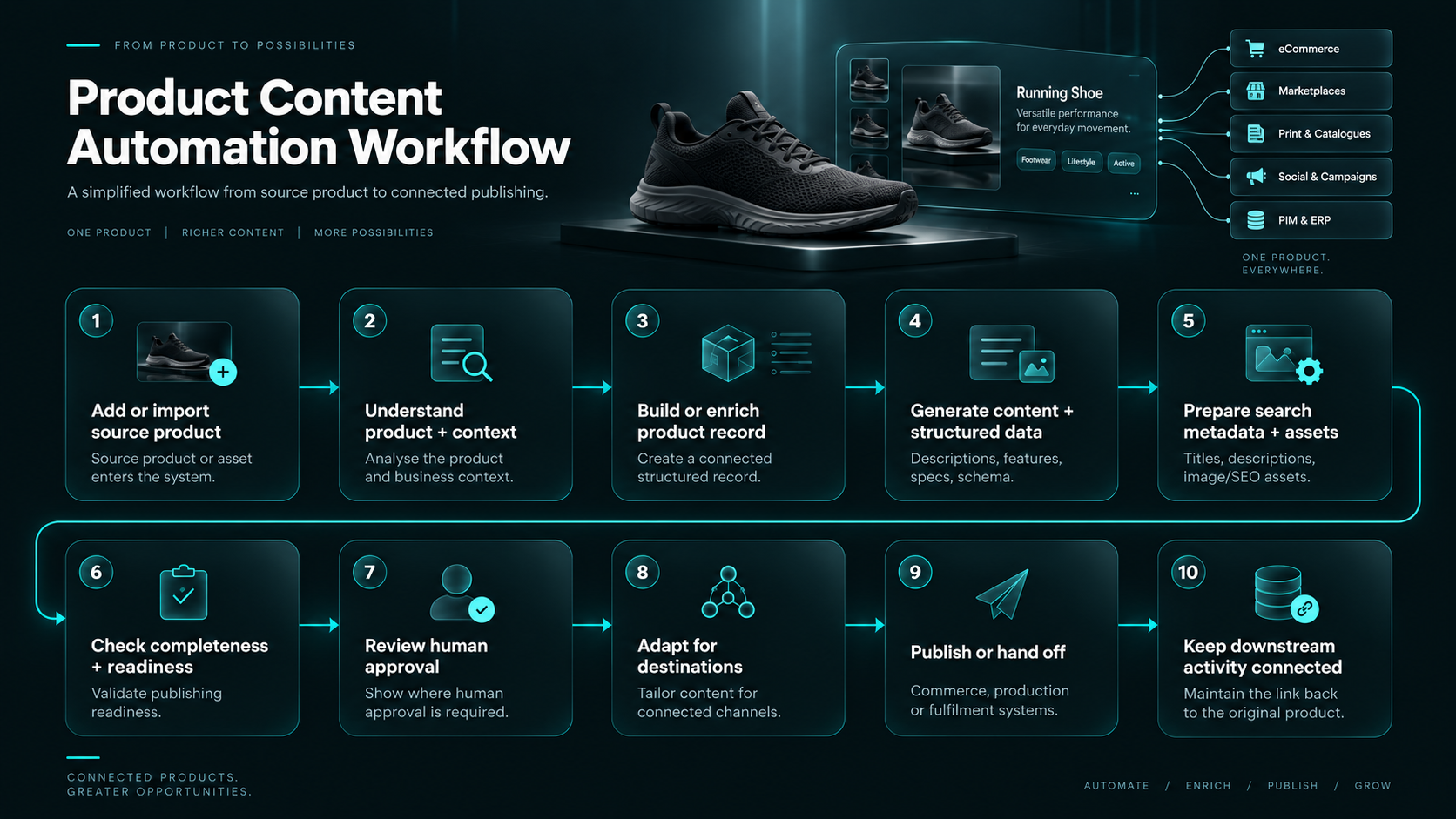
What does a product content automation workflow look like?
A simplified workflow can look like this:
- 1. Add or import the source product or asset.
- 2. Understand the product and available business context.
- 3. Build or enrich the connected product record.
- 4. Generate product content and structured information.
- 5. Prepare search metadata and supporting assets.
- 6. Check completeness and publishing readiness.
- 7. Review where human approval is required.
- 8. Adapt information for connected destinations.
- 9. Publish or hand off to commerce, production or fulfilment systems.
- 10. Keep downstream activity connected to the original product.
What are the benefits of product content automation?
- Less repetitive copy-and-paste work.
- Faster product preparation.
- More consistent product information.
- Better reuse of approved content and assets.
- Fewer disconnected versions of the same product.
- A clearer route from product creation to publishing.
- More scalable catalog operations as product volume grows.
The actual benefit depends on the workflow. Automating a broken content process can simply make errors move faster, so the quality of the underlying product model still matters.
Who is product content automation for?
The category can apply across retailers, ecommerce teams, brands, marketplaces, creators and organisations that repeatedly turn source products or assets into publishable catalog information.
For a small creator, the problem may be repeatedly writing listings and preparing mockups. For a larger catalog team, it may be coordinating thousands of attributes and channel variations.
The product content flow
One product source.
Many publishing outcomes.
Product content automation connects the work between a source asset and the content, metadata, media and publishing outputs required downstream.
Asset
Start with a product image, file or source asset.
Product context
Build a reusable understanding of the product.
Content + SEO
Generate connected descriptions, attributes and search metadata.
Derived assets
Prepare channel-ready media and product information.
Publish
Send consistent product content to the places it needs to go.
Publishing destinations
How FacetIO approaches product content automation
FacetIO is being built as a Product Content Automation Platform around a simple principle: upload once, publish everywhere.
The current product direction starts with an asset and connected business context, then brings together product setup, content, SEO metadata, mockups, print information and publishing workflows around one product record.
Shopify, Wix and Printful are represented in the current MVP workflow. The long-term objective is a connected publishing layer rather than a collection of unrelated content generators.
The FacetIO Manifesto explains the product philosophy behind that approach: creative work should create value; repetitive product administration should increasingly be handled by the system around it.
Product content automation and search visibility
Product information is also discovery information. Titles, descriptions, structured attributes, images and metadata can affect how products are understood by storefront search, conventional search engines, shopping surfaces and other machine systems.
That creates a natural relationship between FacetIO and RankMe: product content can be prepared in the publishing workflow while search visibility intelligence evaluates whether the resulting information is clear and technically sound.
The category is still developing
Product Content Management, PIM and PXM are established adjacent disciplines. Product Content Automation is a newer category phrase increasingly being used for AI-assisted workflows that generate, enrich, optimise and publish product information.
MadLabz uses Product Content Automation as FacetIO's primary category because it describes the work the product is intended to remove: the repeated transformation of a product or asset into all of the information and outputs required to move toward market.
Quick Answers
Common questions.
What is product content automation?
Product content automation uses software, rules and AI-assisted workflows to reduce the manual work required to create, enrich, prepare and publish product information.
Is product content automation just AI-written descriptions?
No. Description generation can be one step, but the wider workflow can also cover structured fields, search metadata, assets, review and channel delivery.
How is product content automation different from PIM?
PIM primarily manages authoritative product information. Product content automation focuses more directly on the work performed on and around that information.
What does product content syndication mean?
Product content syndication is the controlled distribution and adaptation of product information into downstream commerce, marketplace or publishing destinations.
Topics
Related MadLabz Products