

AI visibility is becoming an important part of how businesses think about discovery online. Search is no longer limited to a list of conventional search results. People can now ask questions through generative search experiences, AI assistants and answer systems that retrieve information from across the web.
At MadLabz, we use AI visibility to describe how effectively a business and its information can be discovered, understood and represented across AI-assisted discovery experiences. AI search visibility is the search-focused part of that wider idea.
AI visibility is bigger than being mentioned by ChatGPT
Many AI visibility products concentrate on monitoring: how often a brand is mentioned, which prompts trigger it, whether competitors appear more often, or which URLs receive citations. Those are useful outcome measurements, but they describe only one layer of the problem.
Before a system can cite, recommend or accurately describe a business, there is a more fundamental question: is the underlying information available and clear enough to work with?
That is why RankMe AI Ready approaches AI visibility from the foundation upward. Its current focus is AI readiness: the discoverability, clarity and machine-readable business information that can support stronger visibility over time.
AI visibility vs AI search visibility
The two phrases overlap, but they are useful at different levels.
- AI visibility: the broad outcome — how visible and understandable a business is across AI-assisted discovery.
- AI search visibility: the search-specific outcome — how a website or brand appears within AI-powered search, grounded answers, citations and related discovery surfaces.
- AI readiness: the foundation — whether the business information required for those experiences is accessible, structured, consistent and understandable.
This distinction matters because a readiness improvement does not guarantee a citation or recommendation. It improves the foundation on which discovery can happen.
How AI systems discover information from websites
There is no single universal pipeline used by every AI product. Different services maintain different indexes, crawlers, retrieval systems, search partnerships and ranking mechanisms. But several fundamentals repeatedly appear.
Google generative search

Google's current guidance says its generative search features remain rooted in the core Google Search ranking and quality systems. Pages need the same basic foundations that matter for search generally: useful content, crawlability, indexability, clear site structure and a good page experience.
ChatGPT search

OpenAI provides a dedicated search crawler called OAI-SearchBot. Its publisher guidance says sites that want content included in ChatGPT search summaries and snippets should make sure they are not blocking that crawler.
Bing and Microsoft Copilot

Microsoft similarly connects AI-powered discovery to conventional crawling, indexing and ranking foundations. Bing Webmaster Tools now also provides AI performance information for supported citation and grounding experiences.
Perplexity

Perplexity documents PerplexityBot as the crawler designed to surface and link websites within Perplexity search results. This is another example of why crawler accessibility remains part of AI visibility.
The AI visibility model
From being available to being understood.
AI visibility improves when systems can first find useful business information, interpret it correctly and represent the business with enough clarity to use it in an answer or discovery experience.
Discover
Can the system access and find the information that matters?
Understand
Can it identify the business, its products, services and meaning correctly?
Represent
Can it describe the business clearly without losing important context?
AI visibility
The business becomes more usable across AI-assisted search and discovery.
AI readiness strengthens the foundation. AI visibility is the wider outcome.
What can strengthen AI visibility?
No checklist can guarantee visibility across third-party AI systems, but there are several practical foundations a business can control.
- Keep important public pages crawlable and indexable.
- Use clear page titles, headings and content structure.
- Explain the business, products, services, locations and relationships unambiguously.
- Keep factual business information consistent across relevant pages and systems.
- Use structured data where it accurately represents visible content and established search features.
- Publish genuinely useful, original information rather than commodity pages created only to target query variations.
- Maintain strong conventional SEO because search indexes remain an important retrieval foundation.
- Keep important information current as products, services, locations and policies change.
- Make internal links descriptive enough to show how important pages and entities relate.
AI readiness is the foundation of stronger AI visibility
A useful way to think about the relationship is simple: AI readiness is the foundation; AI visibility is the outcome.
A website can be technically accessible yet still be difficult to interpret. A business name may be clear while its services are vague. Important location information may be buried in visual components. Product relationships may be inconsistent. Structured information may conflict with visible copy.
The RankMe AI Readiness Scan examines representative website evidence to identify these foundational issues before making any claims about third-party placement.
What does not guarantee AI visibility?
The growth of AI search has also produced a large number of supposed shortcuts. They should be treated carefully.
- Adding schema does not guarantee an AI citation.
- Creating an llms.txt file does not provide a Google generative-search ranking advantage.
- Repeating AI-related keywords does not make a page more authoritative.
- Breaking every answer into tiny artificial chunks is not a requirement for Google generative search.
- A high score from a third-party tool cannot guarantee placement inside Google, ChatGPT, Gemini, Copilot or Perplexity.
- Manufactured brand mentions are not a substitute for genuine authority and useful information.
Real-world example
What AI-assisted discovery looks like in practice.
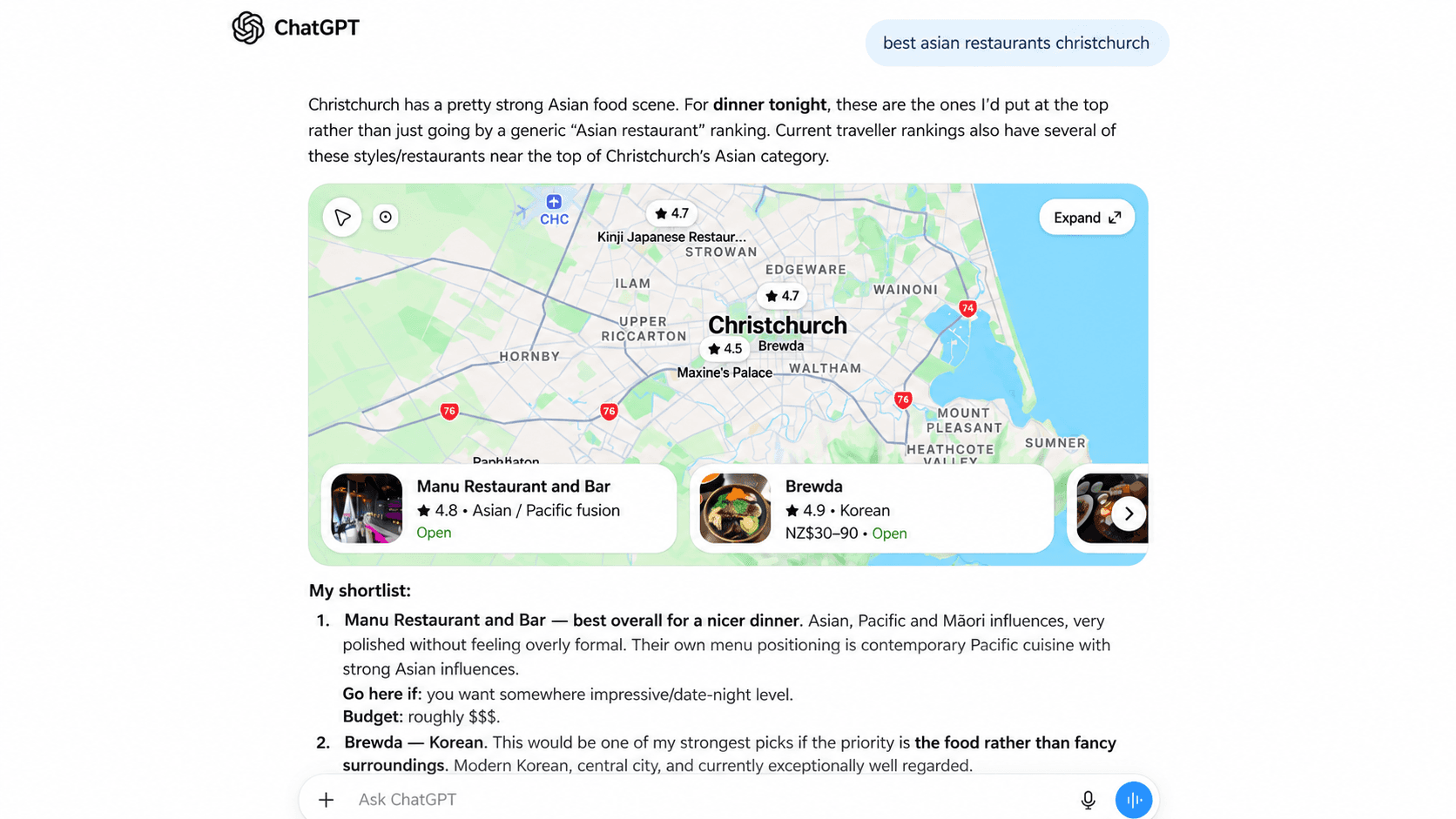
A user asks for a recommendation. The AI system interprets the request, identifies relevant businesses and presents information it considers useful for the answer.
How can AI visibility be measured?
Measurement is improving quickly. Google now provides reporting for generative AI visibility within Search Console, while Bing Webmaster Tools provides AI Performance reporting for supported Microsoft experiences. Referral analytics can also identify traffic arriving from services such as ChatGPT.
Broader monitoring products can track prompt-level mentions, citations and share of voice across different systems. These measurements are useful, but they should be interpreted as observations of particular systems and query sets rather than a universal score of how all AI sees a business.
A practical AI visibility checklist
- Can major search and AI discovery crawlers access the important public pages?
- Are the canonical pages indexable and included in an accurate sitemap?
- Can someone quickly identify who the business is and what it does?
- Are products, services and locations described with enough context to distinguish them?
- Does structured information match what visitors can actually see?
- Are important claims supported with useful detail, evidence or first-hand expertise?
- Do internal links connect related entities and high-value pages clearly?
- Is information maintained when the business changes?
- Can actual search, referral and citation outcomes be measured rather than assumed?
Where RankMe fits
RankMe is being built as a search visibility platform spanning conventional SEO and emerging AI discovery. RankMe AI Ready is the specialised AI visibility product focused first on the readiness layer.
If you want to start with one public page, RankMe Page Check provides a free on-page SEO checker. If the question is whether AI systems can clearly discover and interpret the wider business, start with the free AI Readiness Scan.
Quick Answers
Common questions.
What is AI visibility?
AI visibility is how effectively a business and its information can be discovered, understood and represented across AI-assisted discovery experiences.
Is AI visibility the same as AI readiness?
No. AI readiness describes whether the foundations are in place for machines to discover and understand the business. AI visibility is the broader outcome.
Can SEO improve AI visibility?
Yes. Crawlability, indexing, useful content, clear entities and strong technical search foundations can all support AI discovery, although they do not guarantee citations.
Can anyone guarantee that ChatGPT or another AI system will cite a website?
No. Businesses can improve their foundations and visibility signals, but third-party AI systems ultimately decide which sources they retrieve, use and cite.
Topics
Related MadLabz Products